Terroir – Territories
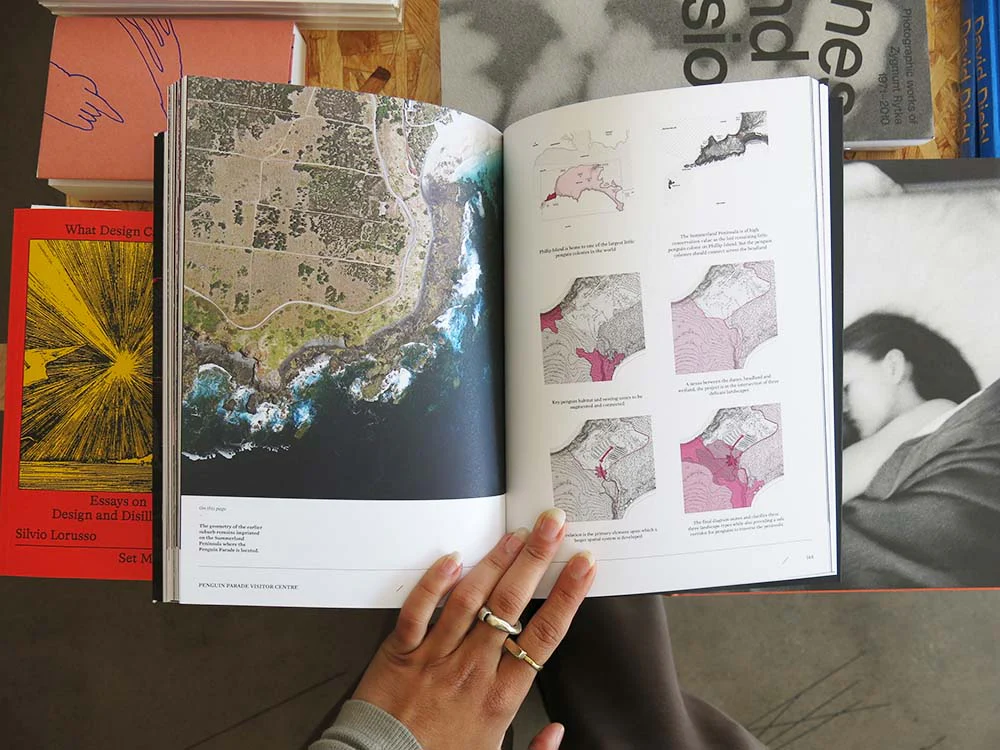
Territories is the third in a series of publications that purposefully reframe what a practice monograph might be. While architecture publishing often treats its subject as self-contained hermetic objects, this publication series challenges this professional convention.Territories repositions architecture as a relational discipline, reversing the logic of building as architecture’s endpoint. Buildings are, rather, the after-effect of relations. And while physical or spatial relations are long-established constituent ingredients of architecture, Territories adds cultural, political, economic and social relations to this architectural repertoire. Seen through this lens, the architect’s scope and agency expands to a network of complex real-world relations, in which designing buildings is only one territory of action.For this reason, Territories departs somewhat from the two previous volumes, Instruments and Third Spaces, which exclusively featured built projects. Territories includes political advocacy, manifestos, strategies and masterplans, as well as buildings.The book divides projects into three distinct categories, from strategic projects at a macro scale, where the outcomes are sometimes not always immediately spatial, to precinct planning at and urban scale, and further, to individual built sites and buildings. Each section is introduced with an essay that contextualises the projects in that section, each as an act of reterritorialisation.At a time when the architect’s role is both under attack and arguably suffering from self-harm, this book offers a bold reassessment of what architecture is and can be. It argues that repositioning is not only possible but also vitally necessary. That is, if architecture wishes to claim any agency to engage with the social, economic and ecological challenges we face today.
Contributors include Bangawarra, Andrew Benjamin, Tarsha Finney, Gerard Reinmuth and Amaia Sánchez-Velasco
224 pages, 25.4 x 17.8 cm, softcover, Uro Publications (Melbourne).
Product Information
Product Information
Shipping & Returns
Shipping & Returns




Terroir – Territories
Terroir – Territories
Territories is the third in a series of publications that purposefully reframe what a practice monograph might be. While architecture publishing often treats its subject as self-contained hermetic objects, this publication series challenges this professional convention.Territories repositions architecture as a relational discipline, reversing the logic of building as architecture’s endpoint. Buildings are, rather, the after-effect of relations. And while physical or spatial relations are long-established constituent ingredients of architecture, Territories adds cultural, political, economic and social relations to this architectural repertoire. Seen through this lens, the architect’s scope and agency expands to a network of complex real-world relations, in which designing buildings is only one territory of action.For this reason, Territories departs somewhat from the two previous volumes, Instruments and Third Spaces, which exclusively featured built projects. Territories includes political advocacy, manifestos, strategies and masterplans, as well as buildings.The book divides projects into three distinct categories, from strategic projects at a macro scale, where the outcomes are sometimes not always immediately spatial, to precinct planning at and urban scale, and further, to individual built sites and buildings. Each section is introduced with an essay that contextualises the projects in that section, each as an act of reterritorialisation.At a time when the architect’s role is both under attack and arguably suffering from self-harm, this book offers a bold reassessment of what architecture is and can be. It argues that repositioning is not only possible but also vitally necessary. That is, if architecture wishes to claim any agency to engage with the social, economic and ecological challenges we face today.
Contributors include Bangawarra, Andrew Benjamin, Tarsha Finney, Gerard Reinmuth and Amaia Sánchez-Velasco
224 pages, 25.4 x 17.8 cm, softcover, Uro Publications (Melbourne).
Original: $78.24
-70%$78.24
$23.47Product Information
Product Information
Shipping & Returns
Shipping & Returns
Description
Territories is the third in a series of publications that purposefully reframe what a practice monograph might be. While architecture publishing often treats its subject as self-contained hermetic objects, this publication series challenges this professional convention.Territories repositions architecture as a relational discipline, reversing the logic of building as architecture’s endpoint. Buildings are, rather, the after-effect of relations. And while physical or spatial relations are long-established constituent ingredients of architecture, Territories adds cultural, political, economic and social relations to this architectural repertoire. Seen through this lens, the architect’s scope and agency expands to a network of complex real-world relations, in which designing buildings is only one territory of action.For this reason, Territories departs somewhat from the two previous volumes, Instruments and Third Spaces, which exclusively featured built projects. Territories includes political advocacy, manifestos, strategies and masterplans, as well as buildings.The book divides projects into three distinct categories, from strategic projects at a macro scale, where the outcomes are sometimes not always immediately spatial, to precinct planning at and urban scale, and further, to individual built sites and buildings. Each section is introduced with an essay that contextualises the projects in that section, each as an act of reterritorialisation.At a time when the architect’s role is both under attack and arguably suffering from self-harm, this book offers a bold reassessment of what architecture is and can be. It argues that repositioning is not only possible but also vitally necessary. That is, if architecture wishes to claim any agency to engage with the social, economic and ecological challenges we face today.
Contributors include Bangawarra, Andrew Benjamin, Tarsha Finney, Gerard Reinmuth and Amaia Sánchez-Velasco
224 pages, 25.4 x 17.8 cm, softcover, Uro Publications (Melbourne).